This is a guest post by Peter Wendes, the Vice President of the British Go Association and Director of Zen Machine, which provides workshops for all levels of Go players.
The ancient strategy game of Go is so minimalist in appearance that it will repel any but the most inquiring minds. Opening the box is for many a disappointing experience- they were hoping for an exciting new game, when all they find is a grid of lines and a handful of black and white pebbles. Yet this was the game beloved of the fierce Samurai, Zen to the core, yet at least a thousand years older than Buddhism.
Chess is a wonderful, deep strategy game, yet Chess players who discover Go, and are willing to explore it, are unlikely to return. Go is a blinding cosmic flash of mindfulness which reduces the arbitrary rules of Chess to ashes. There are many times more possible Go games than atoms- billions of times more, if you’re asking…….
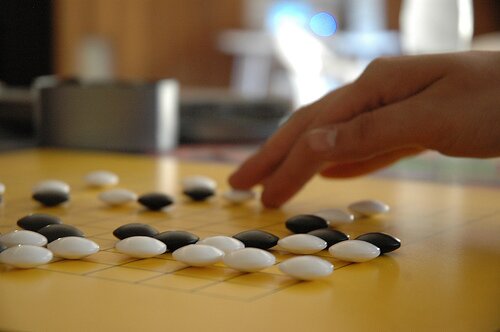
So, how will our Fierce Gentlemen and Ladies get started? A grid is needed- 19×19 is traditional, but 9×9 will serve for beginners. If you like aesthetics, and I’m sure you do, then the squares are not squares, but are slightly elongated as you gaze across the board, to allow for perspective. The ‘stones’ used to play the game are usually black and white, but any contrasting colours will do- and buttons, bottle tops or coins will work until a set of glass Go stones is acquired.
Black plays first. Players take turns to place stones on the intersections, and may play anywhere, even on the edge of the board. At first it’s best to try the ‘light’ version, where the aim is simply to be the first to surround one or more of the enemy stones by blocking all the roads directly around it or them. Ultimately, the aim is to surround more empty space. The stones do not move around the board, but stay where they are placed until they are captured. When no more sensible moves can be made the game ends, and the territory gained is counted. That’s about it. There are a few ‘special case’ rules, but nothing arbitrary- everything comes from ‘surround and capture’.
This often disquieting simplicity is not for the faint-hearted. The apparent emptiness will put off those who love fussy rules, and the challenge is immense. Go has been used to inform military strategy, mathematical research and religious development and has tens of millions of enthusiasts around the world- most credible countries have a national association. Go computer programs have made much progress in recent years, but most local Go clubs will have players who can beat the strongest programs, and no program can come near pro players.
There is of course much information online, though it is still better to have your introduction from a human, face to face. The fierce reader will find that aggression is punished severely, but balanced assertion may prevail. Because of this practical demonstration of the need to weigh gain and loss, and both global and local perspectives, Go is a powerful model for a vast range of human endeavour. Proceed fiercely, but not too fiercely!
Featured image by antitezo via Flickr